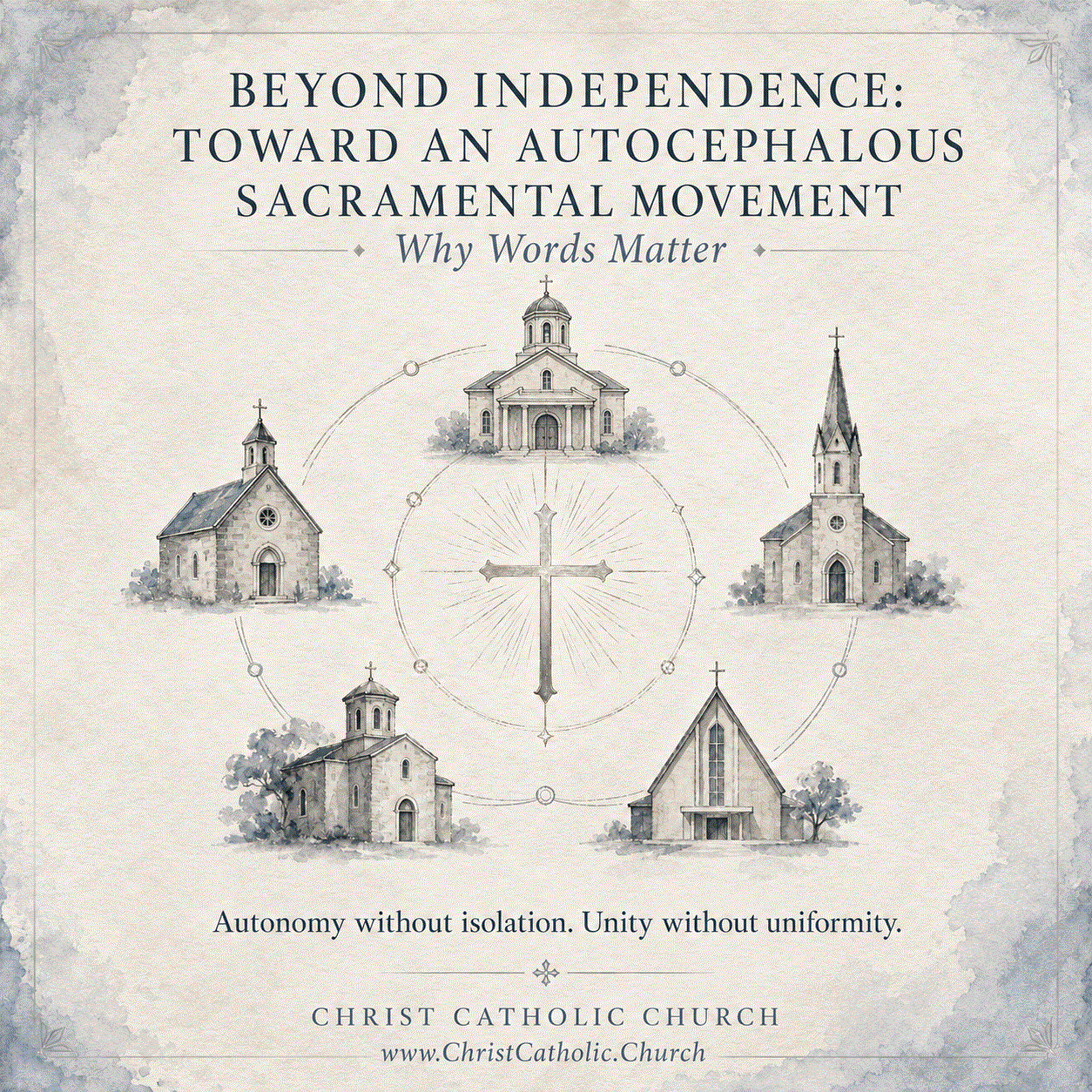
Beyond Independence: Toward an Autocephalous Sacramental Movement
By Abbot Bishop Brian Ernest Brown, CWC
Words matter. They shape more than the sentences we speak; they shape the way we understand ourselves. They create categories in our minds, establish assumptions before a conversation even begins, and sometimes quietly determine which questions we will ask and which answers will seem possible.
That is why I have become increasingly uneasy with the now-common expression Independent Sacramental Movement as the umbrella term for the ecclesiastical world of which Christ Catholic Church is a part.
I understand the term. I use it myself when necessary because people recognize it. There is nothing inherently wrong with independence, particularly when independence means freedom from coercive ecclesiastical structures or the ability of a local church to govern its own affairs. But I wonder whether independent is the best word with which to begin describing who we are.
Words carry baggage. In American culture especially, independence easily evokes rugged individualism: standing on one’s own, answering to no one, needing no one, and defending one’s territory against intrusion. That may be admirable when describing a pioneer crossing the frontier. I am not convinced it is particularly good ecclesiology.
The Church, after all, is not called to independence in that sense. Christianity is inherently relational. We belong to Christ, and because we belong to Christ, we belong to one another. Saint Paul’s image of the Body of Christ makes very little room for rugged ecclesiastical individualism. The hand cannot say to the foot, “I have no need of you.” Yet churches have sometimes become remarkably skilled at doing precisely that.
This is one reason I increasingly prefer the term Autocephalous Sacramental Movement. Autocephalous is an old ecclesiastical word. Literally, it means something like “self-headed.” In the Eastern Christian tradition it describes churches that govern themselves rather than being governed administratively by another ecclesiastical body. An autocephalous church possesses its own internal government and leadership, yet autocephaly does not necessarily mean isolation from the wider Church.
That distinction matters enormously. Independent describes separation. Autocephalous describes governance. Those are not the same thing. A church may be autocephalous and still understand itself as profoundly connected to other churches. It may recognize the sacraments of another jurisdiction, share clergy, cooperate in ministry, participate in common prayer, maintain relationships of friendship and accountability, and even enter formal communion while retaining its own government. In other words, autocephaly does not require ecclesiastical loneliness.
This language is also not foreign to the tradition from which Christ Catholic Church comes. Bishop Karl Prüter used the language of autocephalous churches alongside Old Catholic, Free Catholic, and related terminology long before the expression Independent Sacramental Movement became the fashionable umbrella under which nearly every small sacramental body was gathered.
That is important to me because I am a stickler about words. Words mean something, and sometimes recovering an older word allows us to recover an older way of thinking.
When we begin by calling ourselves independent, we may unconsciously begin with the question, “How do we protect our independence?” That question immediately establishes boundaries. It makes us suspicious of anything that smells like outside authority. Cooperation can begin to feel like surrender. Accountability can appear threatening. Communion can be mistaken for absorption. Before long, every bishop is guarding a little ecclesiastical kingdom and every jurisdiction is defending the fence around its own patch of ground. We have seen enough of that.
The history of our sacramental movement contains extraordinary people, beautiful ministries, courageous experiments in Christian community, and genuine apostolic service. It also contains an almost comical number of divisions, subdivisions, reunifications, reorganizations, episcopal quarrels, disputed successions, renamed jurisdictions, and churches consisting of scarcely enough people to fill a dining-room table.
Sometimes those separations arose from serious matters of conscience. We should not dismiss that. There are theological and ethical differences that cannot simply be papered over for the sake of appearing united.
But anyone who has spent much time in this world also knows another uncomfortable truth: sometimes theological language has provided a very respectable cassock in which wounded pride could dress itself.
An argument about jurisdiction becomes an argument about doctrine. A personality conflict becomes a defense of ecclesiastical principle. A disagreement over precedence suddenly becomes a matter of apostolic integrity. Before long another jurisdiction is born. And then another. This is where terminology matters. If we tell ourselves repeatedly that we belong to an Independent Sacramental Movement, perhaps fragmentation begins to seem almost inevitable. Independence becomes part of our collective self-understanding.
But what happens if we instead understand ourselves as participants in an Autocephalous Sacramental Movement?
The landscape begins to look different. The bishop across town is no longer necessarily the head of a competing independent church. He may simply be the bishop of another autocephalous sacramental community. That church does not need to disappear for mine to exist. I do not need to govern them. They do not need to govern me. Neither of us needs to surrender our identity.
The question then becomes something much more interesting: How might we belong to one another? That is a very different starting place for a discussion about Christian unity. We might remain different churches while sharing a common table. We might recognize one another’s ministries without creating another enormous ecclesiastical bureaucracy. We might cooperate in formation, theological education, charitable ministry, clergy support, and mission. We might establish relationships of communion while maintaining legitimate differences in spirituality, liturgy, discipline, governance, and theological emphasis. We might even disagree strongly and still refuse to declare one another enemies. That begins to resemble something much older than modern denominationalism.
The ancient Church itself was not a single worldwide corporation governed through one administrative headquarters. It was a communion of local churches, Alexandria, Antioch, Jerusalem, Rome, Constantinople, and countless smaller communities, each possessing its own life while recognizing that it belonged to something larger than itself. Their relationships were certainly not always peaceful. Church history should cure us quickly of romantic notions about that. Christians have been arguing almost as long as Christians have existed. Yet underneath the arguments was an important conviction: the Church could possess many local expressions and still somehow be one.
Perhaps that is where the language of autocephaly can help us. It gives us a way to speak about autonomy without isolation. It permits diversity without demanding fragmentation. It allows us to imagine communion without domination. And it leaves room for unity without uniformity.
This does not mean that I expect the term Autocephalous Sacramental Movement suddenly to replace Independent Sacramental Movement. Language develops organically, and ISM has become recognizable shorthand in books, conversations, social media groups, and among many of the people who inhabit this ecclesiastical world.
Nor am I interested in beginning another argument over terminology. That would be wonderfully ironic: splitting the movement into rival camps over what we should call a movement notorious for splitting into rival camps. I am suggesting something much simpler. Perhaps we should think carefully about what our words teach us to believe about ourselves.
For my part, Autocephalous Sacramental Movement may be the most accurate umbrella term we presently have. It describes the reality that many of our churches are sacramental, episcopal, historically connected to Catholic Christianity, and self-governing without requiring the conclusion that they must therefore be isolated from one another.
It describes what we are, rather than primarily what we are independent from. And perhaps that subtle change in language could help produce a subtle change in imagination. Instead of asking how fiercely we must defend our independence, perhaps we could begin asking how responsibly we should exercise our autocephaly. Instead of asking whose jurisdiction should absorb whose, perhaps we could ask how jurisdictions might cooperate. Instead of asking who possesses enough legitimacy to sit at the table, perhaps we could make the table larger. Instead of trying to create unity through organizational uniformity, perhaps we could cultivate communion through relationship.
None of this solves the problems of our movement. A better word will not heal wounded egos, resolve theological disagreements, repair broken relationships, or erase a century of ecclesiastical fragmentation. But words matter because words establish the ground upon which those conversations take place.
If we begin from independence, we may instinctively defend separation. If we begin from autocephaly, we can acknowledge our legitimate autonomy while still looking outward toward communion. And perhaps the future of this strange, beautiful, frustrating, deeply sacramental corner of the Church will not be found in creating one enormous jurisdiction into which everybody must fit. Perhaps it will look more like a communion of communions: many churches, many communities, many traditions and charisms, each possessing its own integrity, yet choosing freely to recognize Christ in one another.
Self-governing, but not self-absorbed. Autonomous, but not isolated. Different, but not divided. Many, and somehow still one.
That, at least, seems to me a much better place from which to begin a larger conversation.