Bringing the Sacraments Closer to Home
By +Brian Ernest Brown, CWC
There are sacramental deserts all across this country. Some are out on the county roads, where getting to Mass means putting a good many miles on the car before you’ve even said the opening prayer. Others are in cities, where a church can be a few miles away and still take two buses to reach. Add a Sunday shift, a bad back, or a car that won’t start, and what looks like a manageable trip on a map can put regular sacramental worship out of reach. I believe the house church ought to be central to the Church’s missionary work in this century. If folks have to go that far to come to the table, some of us need to carry the table a little closer to them.
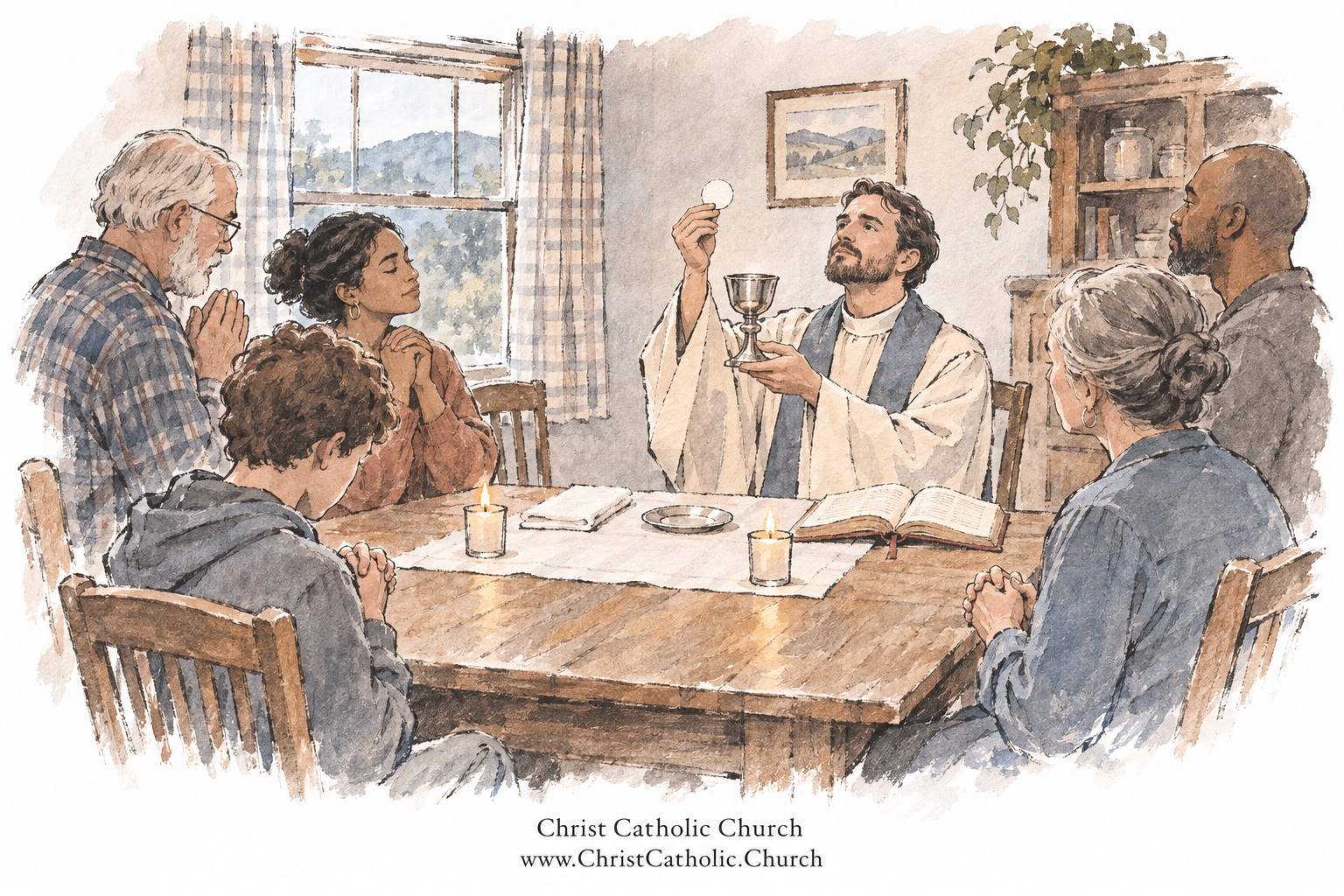
My old mentor, Bishop Karl Prüter, understood something about this. In “The House Church Movement”, he takes us back to the upper room and to the households that Paul greets in his letters. Then he tells us about setting the table for the Eucharist at the very place where his family ate supper. That’s the part I keep coming back to. The table where you pay the bills and where somebody’s child has left a ring from a glass of milk is a place where Christ comes to meet you. And when the same few people gather there often enough, they begin to notice who’s missing, who’s had a hard week, and who could use somebody to sit with them awhile. Fr. Karl saw that knowing one another was part of learning to love one another.
That brings me to a question for those of us in the Independent Sacramental Movement. We have hundreds of bishops, priests, and deacons scattered across the country. How many of us know where the nearest sacramental desert is? I ask that as a bishop, and I ask it of myself. We can spend a good deal of time talking about where our orders came from. I’d like us to spend at least as much time talking about where those orders might take us. A bishop can help a small community find its feet and make sure its leaders have someone to call. A priest can commit to showing up regularly to celebrate the Eucharist and care for the people. A deacon can help keep the needs of the neighborhood before the congregation and carry the congregation’s care back out into the neighborhood. And laypeople may know the place and its people better than any of us. They ought to have a hand in shaping the church from the beginning.
The Sacramental Community Church is the missionary outreach and church-planting ministry of the Sacramental Community of the Coworkers of Christ, chartered and sanctioned by Christ Catholic Church. Through it, we seek to renew existing communities and plant new ones wherever folks have little access to the Sacraments, including people who’ve been away from church for years or have never had a church home. I’d begin by listening. Who’s already praying together? Who’s been making that long drive? Who might come if they could get through the door with a walker? The answer might lead us to somebody’s living room, the back room of a shop, or a borrowed community hall. As a worker priest who earns his living at a glass torch, I know how much of a person’s life happens on the other side of Sunday morning. A regular gathering at a time people can actually make gives a community something it can build a life around. Our covenant to build up the Church
Our Common Rule gives these communities a shared life and room to pray in ways that make sense where they live. One gathering might celebrate Mass with incense and chanted psalms. Another might draw on the Celtic tradition and leave generous room for silence. Still another might come to the Eucharist by way of a familiar hymn and prayers offered in people’s own words. There’s room for all of that in our common life. What matters is that Christ is at the center and that the person who walks in for the first time is given a place, helped to find their way through the liturgy, and invited to share their gifts as the community gets to know them. The Common Rule
What we do around the altar ought to have some bearing on what happens down the street. A community that prays and studies the Gospel together might lend a hand at the local food pantry and, in the course of listening to the folks who come through, learn how many are choosing between groceries and rent. Then the church has a reason to ask what it can do about that alongside its neighbors. That’s part of what I mean when I talk about the Commonwealth of God. When we pray for God’s will to be done on earth as it is in heaven, we’re offering ourselves to take part in the answer. On Earth as It Is in Heaven
A small church can be rooted in its own neighborhood and still have a larger fellowship to lean on. A handful of local people can share responsibility for worship, formation, and outreach, while neighboring communities share resources, mentor new leaders, and come together for retreats and worship. A borrowed room can also leave a little more in the common purse for a neighbor who needs help. Over time, the people who’ve learned to keep a church going in one town may be able to help their neighbors begin one in the next. There’s a kind of growth you can measure in miles people no longer have to drive.
I’d like those of us who feel even a gentle nudge in this direction to take it seriously. Talk with the people already there. See what they’re longing for and what they might have to offer. Find a place where an unfamiliar face can come through the door and be expected back. Then set a day, put another leaf in the table if you have one, and keep coming back. I can think of few better ways for the Church to spend the century ahead.