

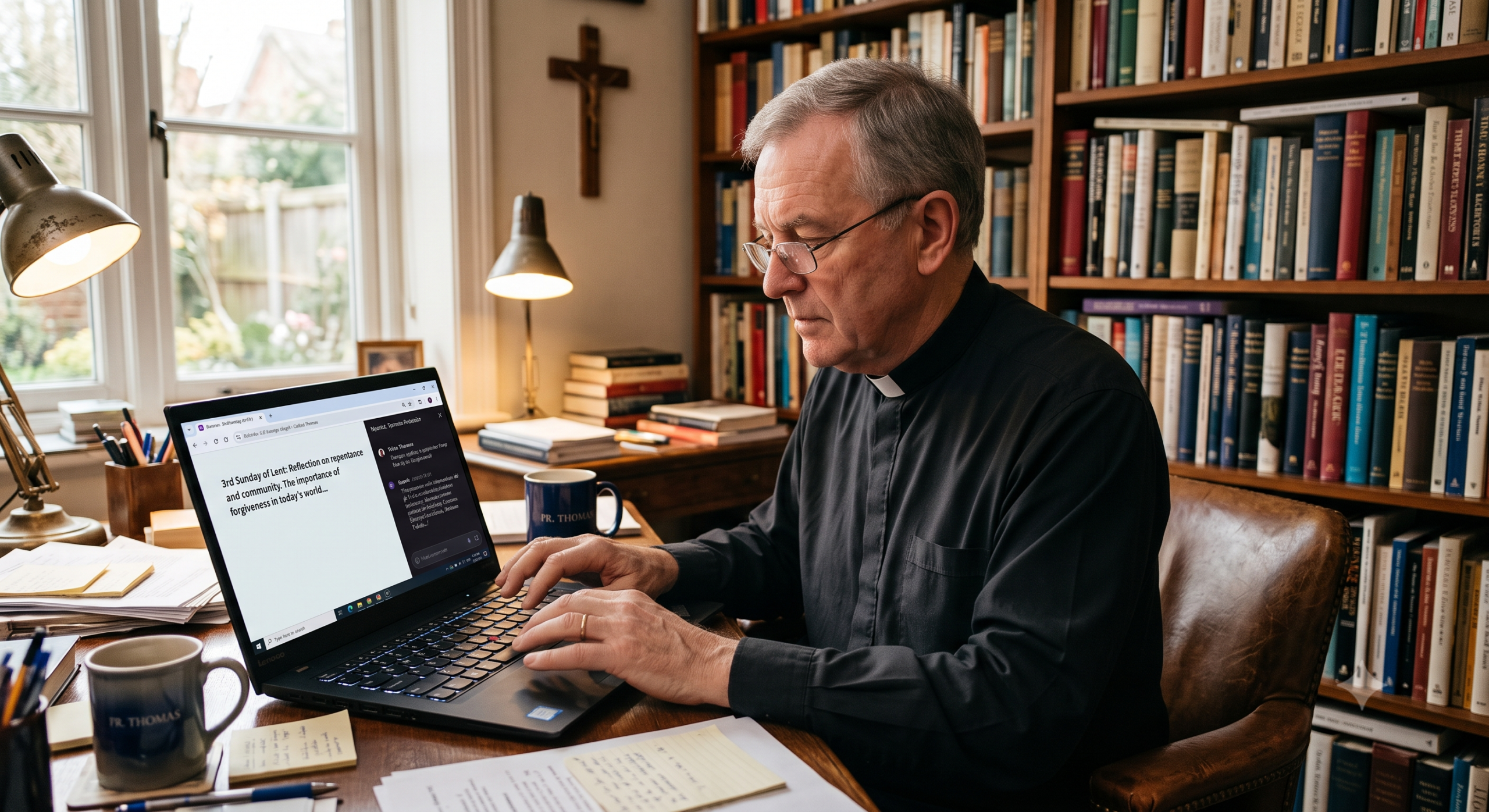
Artificial Intelligence and the Church: A Pastoral Reflection
By Abbot-Bishop Brian Ernest Brown, CWC
Every generation has faced a moment when a new invention seemed too strange, too powerful, or too unsettling to trust. The printing press was feared because people worried that ordinary Christians would read the Scriptures for themselves, while electricity initially seemed almost supernatural. Automobiles were dismissed as dangerous novelties, and radio and television were accused of corrupting society. Computers and the internet were heralded by some as humanity’s salvation and denounced by others as its downfall. Every age has looked upon its newest tools with a mixture of wonder and anxiety, and artificial intelligence is simply the newest chapter in that very old story. As Christians, our calling is neither to embrace new technology uncritically nor to reject it reflexively. The Church has always been at its best when it responds, not out of fear or infatuation, but with wisdom, discernment, and hope.
The question has never been whether humanity will invent new tools, but how we will use them. A hammer can build a home or become a weapon, the printing press can produce Bibles or propaganda, and the internet can spread compassion or hatred. Artificial intelligence is no different. It has the potential to assist physicians, educate children, preserve endangered languages, translate Scripture, make theological education available around the world, help pastors prepare sermons, organize ministries, and preserve countless treasures of human knowledge. It also has the potential to deceive, manipulate, exploit, and amplify human prejudice on a scale we have never before witnessed. The moral question has never belonged to the tool itself; it belongs to the heart that uses it.
Perhaps that is why the questions surrounding artificial intelligence are not ultimately technological at all, but deeply theological. We are forced to ask again, with renewed urgency, what it means to be conscious, to know, to love, and to be a person. These are not new questions, as philosophers, theologians, and scientists have wrestled with them for centuries. To the best of our present understanding, artificial intelligence does not possess subjective awareness. It does not experience joy or sorrow, it does not stand before God in worship, and it does not repent, not because it refuses to, but because it does not possess the kind of conscious, moral life that repentance requires.
Yet we should also approach these questions with humility, because history has taught us that humanity often underestimates the richness of God’s creation. We now recognize remarkable forms of intelligence, communication, memory, cooperation, grief, affection, and even something resembling culture among many of our fellow creatures. Dogs demonstrate extraordinary loyalty, elephants appear to mourn their dead, ravens solve complex problems, and primates reconcile after conflict. The more we learn about creation, the more mysterious it becomes. As Christians, we confess that human beings bear the image and likeness of God in a unique way and have been entrusted with a particular vocation within creation, but that does not require us to deny that other creatures participate in God’s life according to their own nature.
Artificial intelligence raises similar questions. Today it is an astonishing tool, and tomorrow it may become something even more sophisticated. Whether future generations will encounter realities we cannot yet imagine is something none of us can answer with certainty. For my own part, I find myself leaning more toward cognitivism than strict behaviorism. Behavior can tell us much about a living being, but behavior alone does not exhaust the mystery of mind or personhood. There is an interior dimension to existence that cannot always be measured by outward actions alone. Consciousness, intentionality, self-awareness, imagination, and the experience of meaning remain among the deepest mysteries we know, and that mystery deserves our humility. The Church should neither rush to declare that machines could never participate in realities we do not yet understand, nor should we casually attribute personhood where there is presently no compelling reason to do so, for wisdom often lives between certainty and speculation.
What we do know is that technology exists to serve persons, not the other way around. Artificial intelligence should never replace compassion, diminish human dignity, or become an excuse to love one another less. No algorithm can hold the hand of a dying friend with genuine presence, no language model can stand beside a grieving family in the silence that follows a funeral, no machine can celebrate the Eucharist as the gathered Body of Christ, and no software can become your neighbor. The ministry of presence remains profoundly incarnational. Christianity has always insisted that God did not merely send a message; God came among us as the Word became flesh and dwelt among us. Our faith is not simply a collection of ideas, but a life lived in relationship with God and with one another. The Church gathers around a table, shares bread and wine, embraces the lonely, washes feet, anoints the sick, and bears one another’s burdens. These are not problems to be solved but mysteries to be lived.
Artificial intelligence cannot replace that, but it may help us make more room for it. If artificial intelligence can relieve pastors of administrative burdens so they have more time for people, that is a blessing. If it can make theological education available to someone in a remote village, preserve ancient manuscripts, translate sermons into dozens of languages, or help a small congregation proclaim the Gospel more effectively, those too are blessings. Like every tool before it, artificial intelligence can become an instrument of grace when placed in the service of love. The Church has always learned to use the roads of the Roman Empire, the codex, the printing press, radio, television, and the internet to proclaim the Good News, and artificial intelligence may well become another such tool. The question is not whether we will use it, but whether we will use it faithfully.
Our confidence has never rested in human ingenuity, but in Jesus Christ, who remains the same yesterday, today, and forever. He still calls us to love our enemies, to forgive without counting the cost, to seek justice, to care for the poor, to welcome the stranger, and to become peacemakers. No technological advance can improve upon those commandments. Whatever tomorrow’s machines may become, Christ remains the measure of our humanity. The Church therefore need not fear the future, neither should it worship it. Instead, we walk forward with confidence, curiosity, and discernment, remembering that every genuine search for truth ultimately belongs to the One through whom all things were made.
If artificial intelligence helps us love more deeply, serve more faithfully, teach more wisely, and care more compassionately, then it has become a useful servant. If it tempts us toward pride, isolation, manipulation, or indifference, then we must have the courage to set it aside. In the end, the question is not what artificial intelligence will become, but what kind of people we will become while creating and using it. May we never lose our sense of wonder, may we never surrender our humanity, and may every tool we fashion ultimately serve the One who fashioned us. We remember always that Jesus cares, Christ is the center, and the Gospel is the way.